How Do You Decide What Belongs In Your Product?
Ironically, the biggest threat to getting things done: is knowing what to get done. In our book Product Leadership we dedicated an entire section to this topic. More recently, we ran several surveys to confirm this challenge. In a survey of over 100 product professionals and using polls across twitter and LinkedIn the results were the same: prioritization keeps you awake at night.
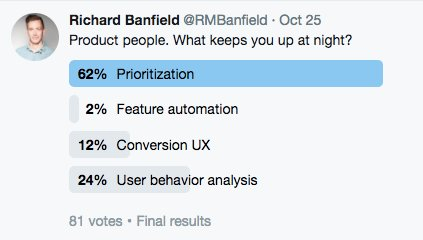
Why Is Prioritization So Hard?
Product creators are given a lot of responsibility, but often without all the authority to get things done. Executives are pushing requests down to their teams while customers and sales people are bubbling up requests for custom features and bug fixes. It’s hard to say no.
We’ve observed that most product managers and leaders don’t have such a method. These product pros need a simple method for filtering out what items are critical and what items can wait. Too many are relying on sales pressure, senior opinion or consensus as their filter. They need help.
What they need is an instruction manual, not another manifesto.
How Do You Filter The Priorities?
It starts with having a clear vision and a path to get there. But what if you don’t even have that? The good news is there is a simple and elegant solution for that too. “We saw it was very rare that products were driven by a compelling vision. We all had tried to build great products throughout our careers, but we didn’t have a clear path. We compared notes and put rigor around a process to create vision-driven products.” — Radhika Dutt
They are calling it Radical Product, and it feels pretty rad to me.
Step 1: Creating A Product Vision
Their Radical Vision Worksheet guides you through a few basic steps towards a clear, concise vision. Whether you’re a startup founder, or a product leader, Dutt, Aggarwal and Kaytes recommend that you do this exercise with your team.
The worksheet makes it easy to generate a first pass of the vision and then iterate on it with the team. Here’s the worksheet…
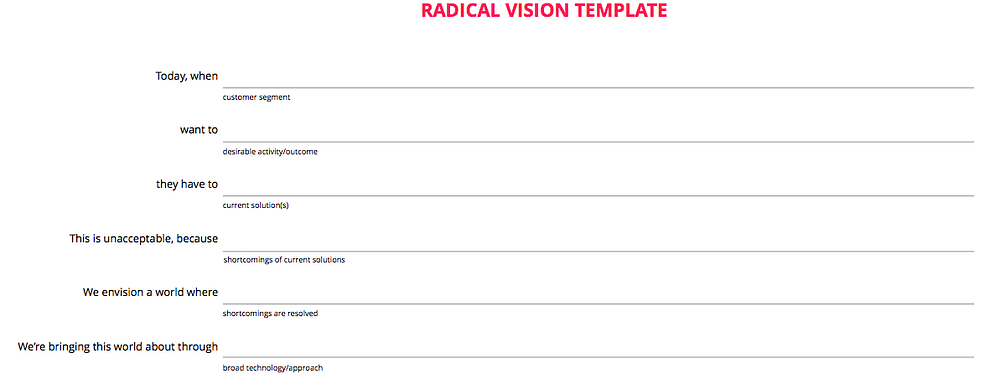
Here it is in Mad Libs form…
Today, when [customer segment] want to [desirable activity/ outcome], they have to [current solution] . This is unacceptable, because [shortcomings of current solutions]. We envision a world where [shortcomings resolved]. We are bringing this world about through [basic technology/ approach].
Step 2: Connecting Vision To Product Strategy
In the Radical Product model there are four components to good product strategy: Real Pain Points, Design, Capabilities and Logistics.
- Real Pain Points means “Who is it for?” and “What is their pain point?”
- Design refers to “What key features would you design into the product?” and “How would you describe your brand and voice?”
- Capabilities tackles the “Why should we be the ones doing it?”and “ What is our unique capability?”
- Logistics is the economics and channels, like “What’s our pricing strategy?” and “What’s the medium through which we deliver this?”
Mapping these out in the grid below gives your team a basic roadmap to help prioritize the timing of their efforts.
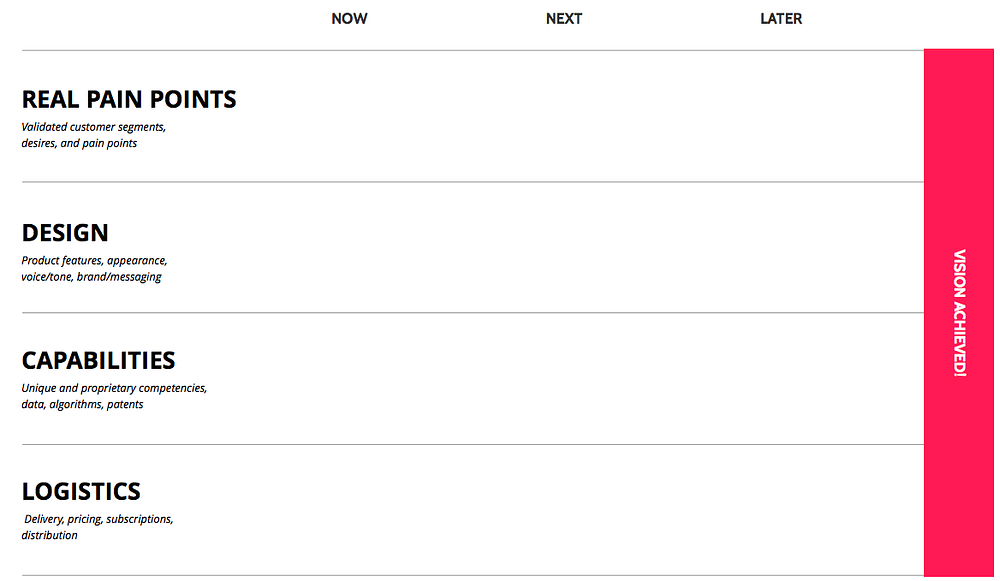
The authors of Radical Product suggest filling out each row in your product strategy and then regularly revisiting it’s contents.
Step 3: Applying The Vision To Prioritization
The simple 2x2 rubric below can be used to evaluate what needs your team’s attention and what can be postponed or ignored. Using the vision to filter tasks or work, you can determine what needs to be done and what needs to be avoided.
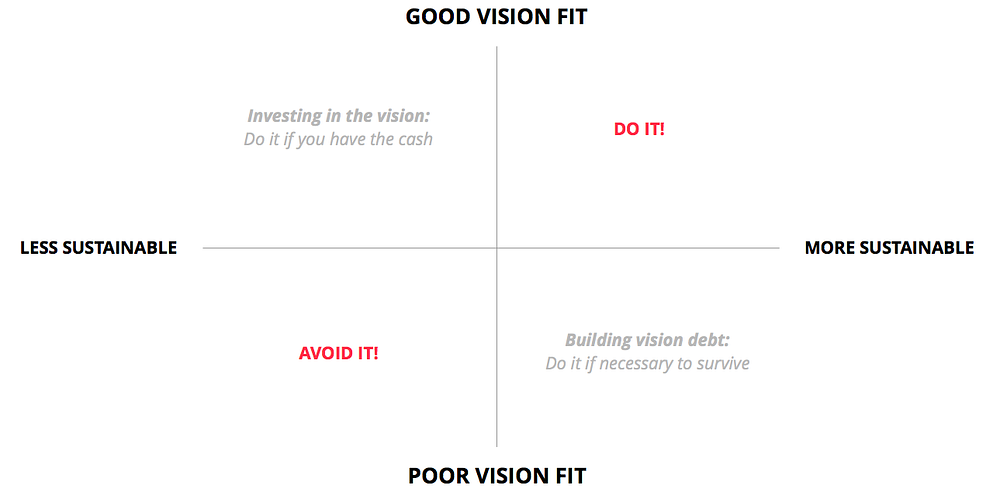
Prioritizing Between Sustainable & Good Fit
If you have the cash, invest in the vision. Especially if you can convince your investors or even customers. If you desperately need the cash, take on vision debt, but just like tech debt, plan to fix your vision debt later.
More tricky is if good vision fit and less sustainable or if it’s not a good vision fit but takes care of some sleepless nights :) — Nidhi Aggarwal
Step 4: Align Analytics With Product Vision
Execution without measurement is pointless. You need to know what prioritization lead to what outcome. You can only improve what you measure. Unfortunately most product teams are still measuring vanity metrics and outputs instead of outcomes tied to customer happiness and revenues.
This final topic that deserves a lot more detail. I highly recommend watching Nate Walkingshaw’s Mind The Product presentation on this topic and reading Dutt’s thoughts on product analytics and measurement.
Comments
Post a Comment